
Climate changes
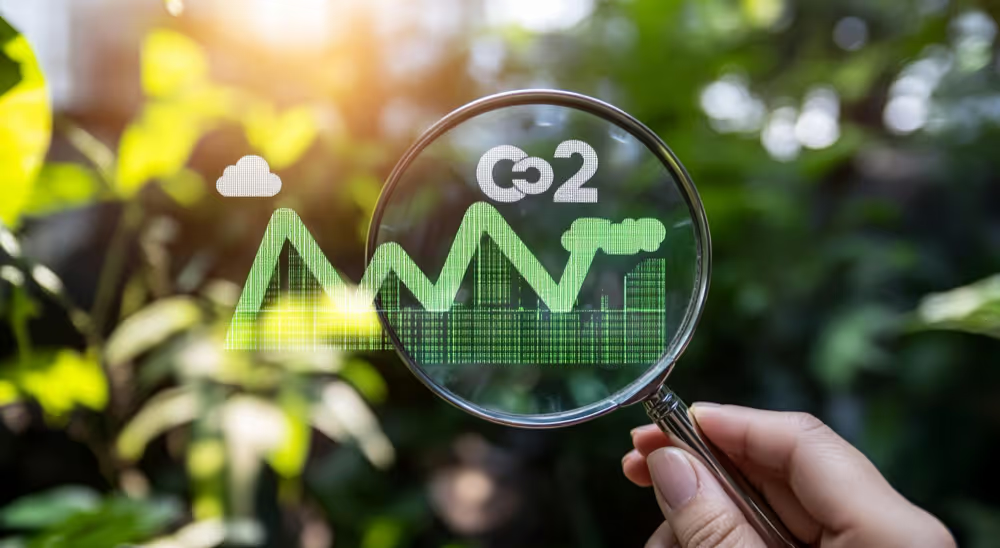
In sustainability discussions, many companies have begun to focus on reducing carbon emissions. However, as climate strategies mature, one issue consistently emerges as the greatest challenge, namely Scope 3 emissions.
According to multiple global sustainability studies, more than 70 percent of corporate emissions originate from Scope 3. This means that most business carbon footprints actually come from activities beyond a company’s direct control, such as supply chains, distribution, product use by consumers, and waste management.
This is why Scope 3 emissions are often referred to as the most difficult emissions to control.
Scope 3 emissions include all indirect emissions that occur across a company’s value chain. Unlike Scope 1, which comes from direct operations, and Scope 2, which comes from purchased electricity, Scope 3 covers third-party activities connected to the business.
These include raw materials produced by suppliers, transportation and logistics, business travel, product use by customers, and emissions generated at the end of a product’s life cycle. In many sectors, particularly manufacturing, FMCG, and technology, the largest share of emissions is often found at this stage.
The core challenge of Scope 3 lies in limited control. Companies do not directly control how suppliers manufacture goods or how consumers use products. As a result, emission reduction efforts require collaboration across multiple stakeholders.
Data availability is another major barrier. Many companies still rely on estimates because supplier emission data is either unavailable or not standardized. Differences in methodologies, partner readiness, and reporting quality mean that Scope 3 calculations require a more flexible yet consistent approach.
Across many industries, supply chains account for the largest share of emissions. Raw material production, third-party manufacturing processes, and cross-border transportation all contribute significant carbon footprints.
Without clear supply chain mapping, companies often struggle to identify their main emission hotspots. This is why data transparency and supplier engagement are essential for managing Scope 3 emissions effectively.
Scope 3 emissions are no longer optional. Investors and regulators increasingly demand broader transparency around value chain emissions. Global standards such as GHG Protocol, Science Based Targets initiative, and evolving ESG regulations encourage companies to move beyond reporting only Scope 1 and Scope 2, and begin mapping Scope 3.
For many organizations, this marks a turning point. Without reliable Scope 3 data, risks related to reputation, regulatory compliance, and access to capital may increase.
Managing Scope 3 emissions is not about achieving perfection overnight. A more realistic approach is to move forward in phases. Companies can start by identifying the most significant Scope 3 categories, using the best available data, and building long-term collaboration with key suppliers.
Over time, data quality and emission reduction strategies can continue to improve. This process allows companies to make progress without waiting for ideal conditions.
Technology plays a critical role in simplifying Scope 3 measurement and monitoring. Digital platforms help companies collect data from multiple sources, apply relevant emission factors, and present insights in a clear and actionable way.
A data-driven approach enables organizations to identify emission reduction priorities and make more strategic decisions.
Scope 3 emissions reflect the complexity of modern business. Emissions are no longer solely about internal operations, but about how companies interact with their broader ecosystems.
By understanding the characteristics of Scope 3 and the challenges involved, companies can take more focused steps on their decarbonization journey. Managing the largest emission sources may be difficult, but this is also where the greatest impact potential lies.
Emissions management cannot be done in isolation. Scope 1, Scope 2, and Scope 3 are interconnected and together form a complete picture of a company’s carbon footprint. Without a holistic approach, emission reduction efforts risk being misaligned and difficult to measure.
Through CarbonIQ by Jejakin, companies can calculate, monitor, and analyze Scope 1, Scope 2, and Scope 3 emissions within a single integrated platform. Data collection becomes more structured, calculations more consistent, and reporting aligned with global standards such as GHG Protocol.
With accurate data, organizations can identify major emission sources, prioritize reduction efforts, and develop more credible and measurable decarbonization strategies.
If your company is ready to manage emissions comprehensively and based on data, the Jejakin team is here to support you.
Contact us to take the first step toward managing Scope 1, Scope 2, and Scope 3 emissions.


Jejakin’s green programs combine high-tech monitoring, biodiversity restoration, and community-led initiatives to deliver powerful, sustainable change across ecosystems.


